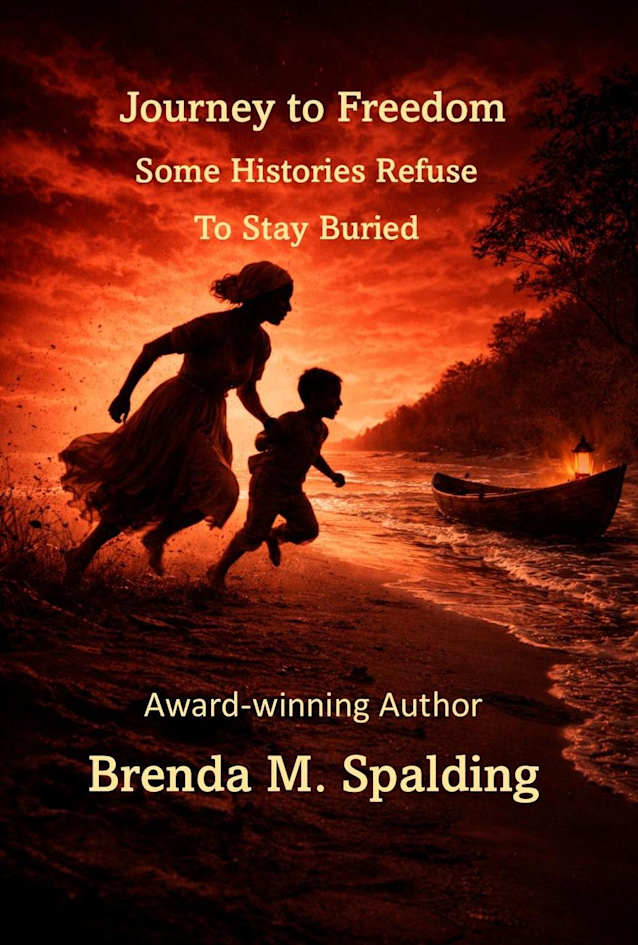
Journey to Freedom
About
After the death of her mother, high-school history teacher Gabby Rivera relocates with her husband, Eric, to a small Florida town for his new job. Their craftsman-style home sits directly across from Manatee Springs State Park, a place that unsettles Gabby in ways she cannot explain. The land feels watchful, heavy with meaning, as though it recognizes her.
Gabby soon learns the park occupies the forgotten site of Angola, a thriving maroon settlement destroyed in 1821 during U.S. military raids. Official records reduce Angola to a footnote—if they mention it at all—but Gabby begins to encounter gaps, altered documents, and warnings passed down through generations. At the same time, she senses the presence of Josiah, a young man who lived in Angola before the raid. Through Josiah’s voice, the novel reveals daily life in the settlement community, joy, preparation, and the quiet knowledge that freedom sometimes required movement.
Josiah’s memories expose the truth behind the Saltwater Railroad, a perilous escape route that carried self-emancipated people south by canoe through Florida’s waterways and across open sea to the Bahamas and beyond. As Gabby’s research deepens, descendants begin to surface—elders recalling whispered rules, teenagers discovering erased lineages, and families who carried Angola’s memory across water and time.
Gabby’s growing determination draws resistance from institutional forces determined to keep Angola’s history quiet. A local historian and county officials frame silence as stewardship, while pressure mounts on Gabby’s career and Eric’s livelihood. As intimidation escalates—from bureaucratic threats to physical barriers erected around the park—the land itself seems to push back, refusing to be erased.
When descendants arrive to speak names aloud and submit testimony, the story reaches a turning point. Gabby publicly reads the names removed from the record in 1821, breaking a two-century-long enforced silence. The attempt to suppress the truth collapses under the weight of witness testimony, documentation, and collective memory. The park is reclaimed—not as a monument to tragedy, but as a living site of resistance and survival.
In the aftermath, Josiah’s watch finally ends. The land is protected, the Saltwater Railroad is named, and Angola is restored to history—not perfectly, but honestly. Gabby accepts that telling the truth carries consequences as well as healing, and commits herself to ensuring the story is never buried again.
Told through interwoven perspectives of the living and the dead, this novel explores how history survives through community, how silence is maintained by power, and how memory—once spoken—cannot be erased.